
Introduction of B-SES to Provide Exercise Therapy Even for Elderly Patients Without Exercise Habits
– Facility Characteristics
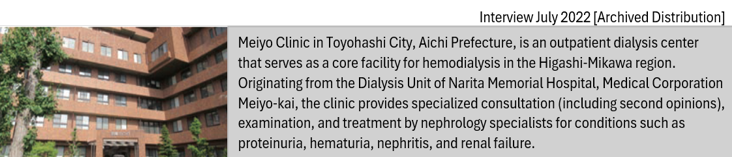
Our clinic was established in April 1996 as a dialysis center, and currently has 148 dialysis beds. The dialysis unit is also equipped with a foot care room, where proactive measures are taken to protect foot health.
– Challenges and Background at the Time of B-SES Introduction
Many of our patients present with complications related to the initiation of dialysis or to long-term dialysis therapy. Nationwide, the aging of dialysis patients is advancing, and the need for countermeasures against sarcopenia and frailty has long been recognized. The average age of patients attending our clinic is 69.6 years, with a high proportion of late-stage elderly.
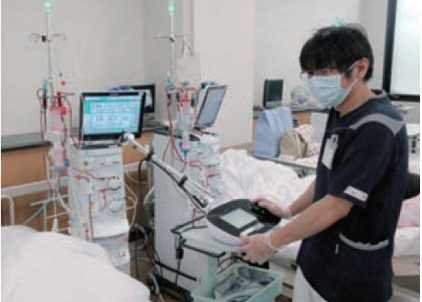
The decline in physical function frequently observed in our patients is largely due to age-related muscle weakness, which, if it progresses, leads to difficulties in daily living and eventually results in the need for nursing care. Consequently, patients require daily life assistance or various forms of long-term care support, and in some cases, caregiving at home becomes difficult, forcing patients to discontinue dialysis visits at our clinic. At our clinic, we aimed to address sarcopenia and frailty, which are commonly seen in elderly patients, at an early stage. By maintaining a healthier condition, we strive to support patients so that they can safely continue outpatient dialysis. It is well established that prevention of sarcopenia and frailty requires adequate protein intake, aerobic exercise, and resistance training. This necessitates nutritional management as well as individualized exercise therapy tailored to each patient’s condition and lifestyle. However, for elderly patients without exercise habits, this is often difficult. For this reason, in 2019 we introduced B-SES, which provides muscle stimulation through electrical impulses during dialysis, allowing patients to experience muscle contractions without voluntary effort.
Increased Peripheral Blood Flow After B-SES and Expectations for Peripheral Artery Disease Prevention
– Purpose and Expected Effects of B-SES
The purposes of introducing B-SES include prevention of lower limb muscle weakness in patients requiring assisted walking or walker use, and maintenance of lower limb strength in wheelchair users. It is also used for patients with pain such as low back pain, and for elderly patients who have difficulty walking long distances. The intended effects at the time of introduction were to maintain and improve lower limb muscle strength, alleviate pain and numbness in the lower back and lower limbs, and improve patients’ ADL (Activities of Daily Living). In addition, as part of evaluating lower limb blood flow and preventing progression of peripheral artery disease, we conduct simple monthly assessments of peripheral blood flow volume. Measurements taken after B-SES sessions showed increases compared to pre-treatment values, suggesting that electrically induced muscle contractions contribute to increased peripheral blood flow. Therefore, B-SES is also expected to play a role in the prevention of peripheral artery disease.
– Patient Feedback
Patients have shared comments such as:
“It has become easier to stand up and sit down than before.”
“My legs feel lighter.”
“Walking has become easier.”
“The pain in my knees has improved somewhat.”
“Pain and numbness in my legs have been reduced.”
“I now have more opportunities to go out for walks and other activities.”
“I feel that the circulation in my legs has improved, and they feel warm.”
“The stiffness I used to feel in my leg muscles has improved.”
In addition, some patients have reported, “I feel more strength in my lower back, which makes it easier to move.”
Monthly Evaluation of B-SES Objectives
– Implementation Within Daily Clinical Practice
B-SES is performed during dialysis treatment, specifically between 30 minutes and 2 hours after the start of dialysis, when blood pressure is stable. The number of patients receiving B-SES per day is approximately up to 5 during the daytime and 2 at night, with a maximum of around 7 patients per day.
– Method of Implementation: Duration, Frequency, and Modes Used
Each treatment session lasts 20 minutes. On each dialysis day, we consult with patients about their symptoms such as “leg pain,” “numbness,” or “lack of strength,” and adjust the mode and intensity accordingly. During implementation, we observe the patient’s response on that day and provide encouragement, for example: “Shall we try to push a little more next time?” The intensity is adjusted within the range patients can tolerate. For those with back pain or difficulty exerting force, the metabolic mode is used, but in most cases, the disuse mode is applied. B-SES is evaluated monthly, and the results are reported to physicians to determine whether to continue. Evaluations are based on improvements in patient symptoms, such as “walking has become easier,” “pain has decreased,” or “numbness has improved somewhat.” An evaluation sheet lists the purposes of B-SES, and assessments are made against those objectives. Patients who enjoy B-SES often continue long-term, with some cases lasting 1, 2, or even 3 years. For one patient in their 43rd year of dialysis, who had previously experienced amyloid deposition and joint deformity, leading to a decline in muscle mass and difficulty walking independently, gradual improvement was noted after about one year of B-SES. The patient regained some strength in the legs and lower back and is currently able to walk using a walker. Promoting New Initiatives Using B-SES in Light of Insurance Coverage for Exercise Instruction During Dialysis
– Current Medical Fees and Usage Charges
At our clinic, rehabilitation billing is not applicable, so B-SES is calculated under “anti-inflammatory and analgesic procedures (equipment, etc.)” at 35 points. B-SES is primarily recommended for patients with lower limb muscle weakness due to conditions such as arteriosclerosis obliterans or lumbar spinal canal stenosis.
– Response to Insurance Coverage for Exercise Instruction During Dialysis
Among the requirements for billing is “completion of training related to exercise instruction for dialysis patients.” Since our clinic has not yet met this requirement, it is first necessary for our staff to complete the designated training. This year, we have newly established an Exercise Instruction Committee, and we plan for members of this committee to participate in the required training. Furthermore, with reference to the Kidney Rehabilitation Guidelines of the Japanese Society of Renal Rehabilitation, we aim to advance kidney rehabilitation programs feasible at our clinic, including the use of B-SES. Since exercise instruction during dialysis is a new initiative, we also intend to provide patients with information on the necessity of kidney rehabilitation.
Advantages of Introducing B-SES: Consistent Muscle Strengthening Even for Patients Without Exercise Habits
– Benefits of B-SES Introduction
Until now, we had been exploring various methods of strength training that could be performed during dialysis sessions. By introducing B-SES, we are able to provide patients—particularly those without exercise habits—with passive and consistent muscle strengthening that does not interfere with dialysis treatment. In contrast, self-directed exercise often allows patients to adjust the level of training themselves, leading to decisions such as, “I’ll stop here for today.” With B-SES, however, a fixed prescription and a consistent training load can be applied, ensuring that patients receive the same duration and intensity of muscle strengthening during each session.