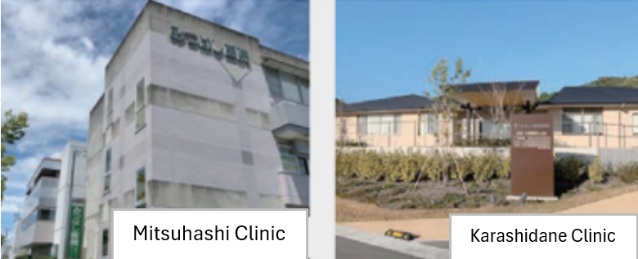
Medical Corporation Fukujukai “Mitsuhashi Clinic” was established in Fukuroi City, Shizuoka Prefecture in 1989 (Heisei 1). Subsequently, the organization opened “Haibara Urology Clinic” (now “Haibara Clinic”) in Makinohara City, “Hiryu Clinic” in Tenryu Ward, Hamamatsu City, and “Karashidane Clinic” in Fukuroi City in 2018 (Heisei 30). Each of these clinics primarily provides dialysis therapy. With the philosophy of offering heartfelt medical care from the patient’s perspective, we strive to contribute to the advancement of community healthcare.

Enhancing Exercise Therapy During Dialysis Through the Introduction of B-SES at Multiple Facilities
– Background of B-SES Implementation at Both Clinics –
In recent years, the number of elderly patients starting dialysis after the age of 80 has been increasing. At the same time, there are also patients who have been undergoing dialysis for 20 or even 30 years. Many of these individuals originally have little to no exercise habits, and with advancing age, frailty and sarcopenia have become significant challenges in dialysis treatment settings. Previously, we had encouraged lower-limb exercises and stretching that could be performed on the bed during dialysis, used pad-type electrical stimulation devices, and provided home exercise instructions. However, these efforts were not sufficient. Upon learning about B-SES, we first introduced it at Mitsuhashi Clinic as part of our exercise therapy initiative. Later, Karashidane Clinic, a newly established facility, also implemented B-SES with the intention of highlighting exercise therapy as one of its defining features.
Encouraging Long-Term Exercise Habits and Maintaining/Improving ADL
– Target Patients and Objectives of B-SES Use –
When using B-SES, we identify suitable patients based on factors such as their exercise habits and the presence or absence of difficulties in activities of daily living (ADL). While many are elderly, younger patients who meet the criteria are also encouraged to participate. The primary goal of B-SES is to foster future exercise habits and to maintain or improve ADL. Indirectly, we also expect secondary benefits such as mental stability and the prevention of cognitive decline. Furthermore, B-SES may improve dialysis efficiency and help prevent cardiovascular events. Ultimately, we believe these outcomes can contribute to an overall enhancement of patients’ quality of life (QOL).
– Patient Feedback –
Many patients have expressed positive feedback, saying, “My legs feel lighter,” “It’s easier to go up and down stairs,” and “I can walk longer distances.” Those who have used B-SES tend to notice the effects and often wish to continue the therapy. Some patients find the stimulation too strong when using the disuse prevention mode and cannot continue. For such cases, we start with the metabolic mode and gradually increase usage as tolerated.
Understanding the Benefits of Rehabilitation — Nurses Taking an Active Role
– Implementation and Operation of B-SES –
B-SES sessions are conducted by nurses during dialysis. Most patients undergo dialysis three times per week, and accordingly, B-SES is performed three times weekly for about 20 minutes each session. Blood flow tends to stabilize approximately 30 minutes to one hour after the start of dialysis, so we typically begin B-SES around that time. In longer dialysis sessions, such as four-hour treatments, some patients may experience a drop in blood pressure after about two hours. Therefore, we perform B-SES before this point to ensure safety and effectiveness. Currently, we mainly use the disuse prevention mode for muscle strengthening. Moving forward, we plan to incorporate the metabolic mode as well, adjusting the settings according to each patient’s condition. Each clinic operates one B-SES unit, allowing treatment for approximately five to six patients per day. At present, patients generally receive B-SES therapy for about three months per course. Our goal is to give as many patients as possible the opportunity to experience B-SES and feel its benefits within that period.
– Reactions from the Nursing Staff –
Because our nurses have prior experience providing anti-inflammatory and pain relief treatments, they have embraced B-SES positively. A team leader is responsible for rehabilitation and muscle-strengthening initiatives using B-SES, and the program is coordinated around that individual. The recent introduction of an additional reimbursement for exercise instruction during dialysis is one factor behind this initiative. Furthermore, increasing evidence supports the benefits of renal rehabilitation, including improved survival outcomes through rehabilitation. Recognizing these advantages, our nurses are proactively engaging in B-SES as not only a part of medical treatment but also an integral element of nursing care.
– Effects of B-SES from a Healthcare Provider’s Perspective –
To assess effectiveness, we measure patients’ body composition before and after B-SES therapy. While only a few patients have shown clear numerical improvements so far, we have observed measurable increases in muscle mass among some younger patients. In the future, we hope to extend treatment periods and encourage patients to continue exercise habits at home. We also anticipate that as muscle mass increases through B-SES, activities of daily living (ADL) will improve, leading to greater physical activity and more tangible, objective results. Additionally, patients often experience drops in blood pressure or leg cramps during the latter half of dialysis sessions. However, since the introduction of B-SES, such incidents have noticeably decreased, suggesting a stabilizing effect on circulation and muscle condition. Effective Use of the Dialysis Exercise Instruction Fee in Combination with Anti-Inflammatory and Analgesic Treatment
– Current Medical Fees and Usage –
The current medical fee is 35 points under anti-inflammatory and analgesic treatment. We identify patients who experience joint pain or other types of pain that interfere with their activities of daily living (ADL) and provide treatment accordingly.
– Implementation of the Dialysis Exercise Instruction Fee –
To claim the Dialysis Exercise Instruction Fee, participation of physicians, nurses, and physical or occupational therapists who have completed relevant exercise instruction training is required. We are currently preparing to meet these conditions. Since the reimbursement period is limited to 90 days, we aim to utilize it effectively by combining it with our existing anti-inflammatory and analgesic treatments. Ultimately, our goal is to improve patients’ ADL and, in the long term, enhance their quality of life (QOL). We hope to use this system as a means to help patients initiate and maintain positive lifestyle changes.
Accessible to All, Regardless of Technical Expertise or Experience
– Institutional Benefits –
Various rehabilitation and pain-relief devices have long been available, but B-SES stands out for its simplicity—it is easy to set up and operate, requiring no specialized skills or prior experience. Patients often report feeling “lighter legs” or “improved ease of movement,” and these tangible results are a major benefit of B-SES implementation.
– Future Initiatives Alongside B-SES –
Although our plans are still in development, we intend to expand exercise instruction programs centered around B-SES. Another focus will be nutritional guidance. Many dialysis patients remain concerned about protein restriction. While such restrictions were emphasized in the past, recent evidence shows that inadequate protein intake can lead to progressive loss of body mass. Therefore, moving forward, we plan to take a more proactive approach, incorporating nutritional counseling to ensure patients maintain sufficient protein intake and overall nutritional balance.