
[Archived Broadcast – March 2023]
Chiba-Nishi General Hospital is an acute care hospital with approximately 600 beds. As a core medical institution in the region, it upholds the fundamental policy of “never refusing emergency patients—open 24 hours a day, 365 days a year.” The hospital receives a large number of ambulance arrivals, attracting patients not only from Matsudo City but also from surrounding areas. In terms of medical specialties, many patients are treated in the field of cardiovascular medicine. The hospital has ranked number one in Japan for twelve consecutive years in the number of cardiac catheterization procedures performed, and its Cardiology and Cardiovascular Surgery departments are well known nationwide.
Appropriate Use of Five B-SES Units According to Patient Condition and Treatment Purpose
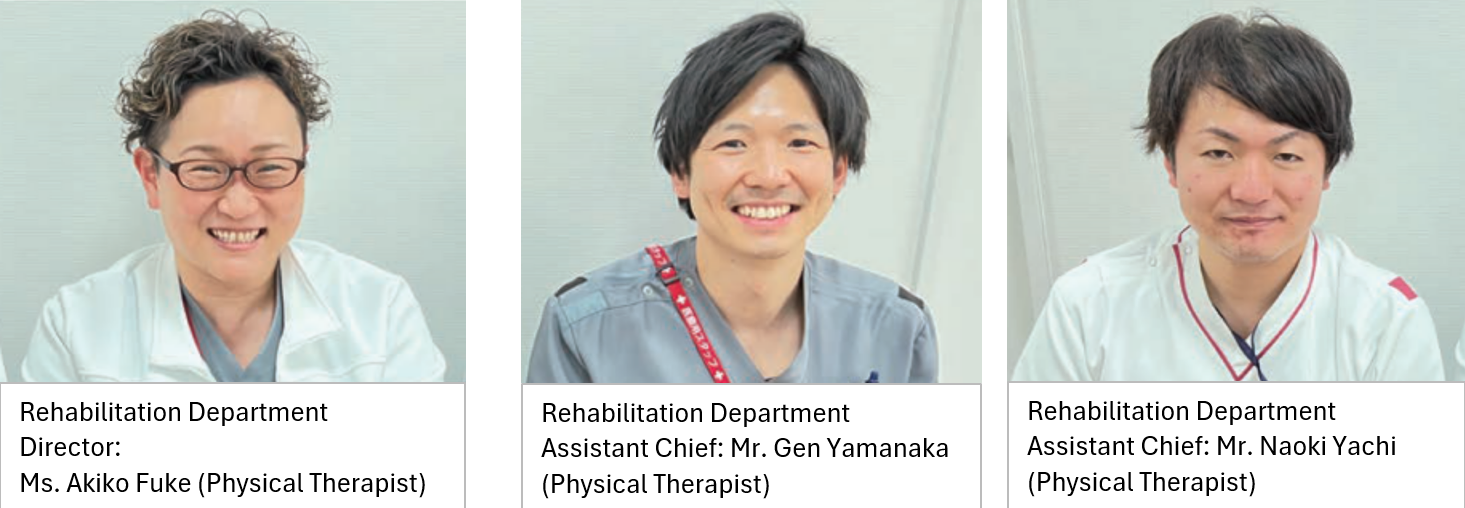
— Features of the Hospital and Rehabilitation Department
PT. Fuke:
Since our hospital treats a wide variety of patients, rehabilitation therapists must be capable of handling all kinds of cases. Therefore, we conduct comprehensive training so that therapists can respond to any patient’s needs. Our patient age range spans from newborns to centenarians. As an acute care hospital, we are well positioned to support early mobilization in accordance with current healthcare trends.
— How We Learned About B-SES
PT. Yachi:
I first learned about B-SES at an academic conference, where I saw it exhibited at a device booth. I also had the chance to personally experience a simple demonstration at the venue. As I was mainly responsible for intensive care, I had long been interested in B-SES as a device capable of inducing muscle contractions through electrical stimulation in bedridden or immobile patients. Now that our hospital has multiple B-SES units readily available, we can use them at any time. Before their introduction, however, I often thought, “I wish we had B-SES for this kind of patient.”
— Departments and Applications of Use
PT. Yamanaka:
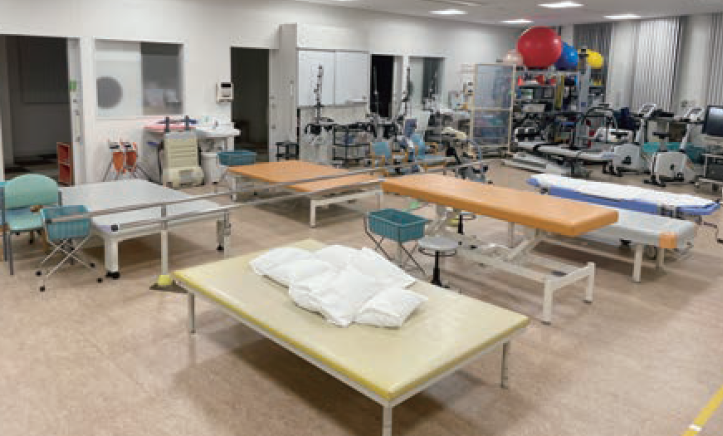
One unit is used in the infectious disease ward for COVID-positive patients. Another is installed in the ICU. The remaining three are managed in the rehabilitation room—one used there directly and two lent to general wards as needed. Among the three units managed by the rehabilitation department, one is operated exclusively with pad electrodes. We use pad electrodes for both outpatients and inpatients, in cases such as facilitation of paralysis or nerve disorders. I personally use B-SES for quadriceps facilitation and for patients with poor postoperative contractions. Common applications include disuse syndrome and spinal cord injury, as well as stroke rehabilitation. We also often use it for patients in cardiothoracic or cardiovascular surgery units who have difficulty moving their bodies. When using it in general wards, its portability allows us to easily bring the device from the rehab room.
— Mode Selection and Adjustment
PT. Yamanaka:
We switch between the muscle training mode and the aerobic exercise mode depending on each case. For patients with unstable circulation, we use the aerobic mode. For those under load management who cannot walk, we combine both modes to help maintain muscle strength—for example, “muscle training → aerobic exercise → muscle training.”In some cases, we conduct up to 60 minutes of B-SES sessions per day, tailoring individual programs to each patient’s condition.
— Ease of Belt Attachment and Device Operation
PT. Yamanaka:
Younger patients tend to understand how to use devices more quickly. In orthopedics, after we prescribe B-SES and demonstrate its use a few times, some patients can operate the device by themselves. Because the belts are easy to attach, we often instruct patients on how to wrap them initially, and then allow them to do it on their own afterward. At the start of treatment, we simply tell them, “You can start now,” and track the treatment duration. Interestingly, when B-SES is in use, electrical noise appears on the ECG monitor. We sometimes take advantage of that as a remote indicator to confirm that stimulation is being applied.
— Versatility of B-SES
PT. Yachi:
I once used B-SES on a patient with Leriche syndrome (aortic occlusion) and presented the case at a medical conference, which was well received.I have also applied B-SES in parallel with a tilt table for paraplegic patients—adding mild electrical stimulation while applying weight-bearing load to simulate a dual-input effect. When observing muscle movement in a supine position, the muscle response appeared better than during standard stimulation, so I occasionally adopt this approach depending on the situation. Would you like me to adapt this translation into a formatted publication version (e.g., suitable for inclusion in a brochure or medical case report layout, with headings and pull quotes)?
Safe Implementation of B-SES in ICU and Pediatric Settings
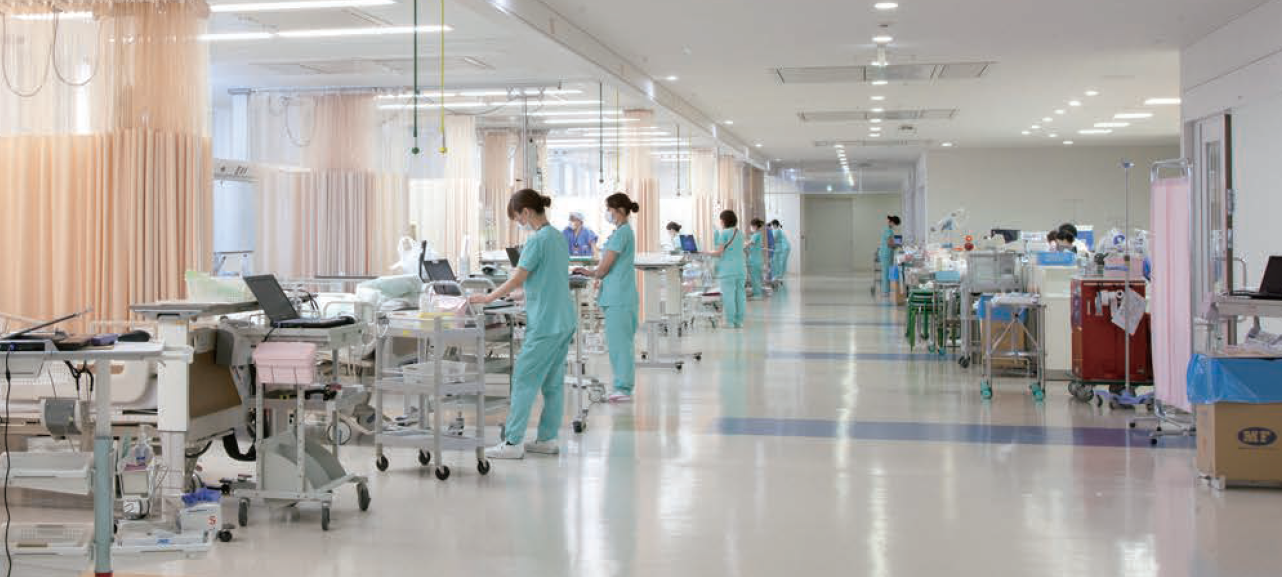
— Use of B-SES in the ICU
PT. Yachi:
At present, physical therapists are responsible for both setting up and operating B-SES. Ideally, it would be more seamless if nurses could also handle the device; however, in the ICU, patients are often connected to multiple lines and monitoring devices, making the attachment of B-SES somewhat complicated. For that reason, it is currently managed by physical therapists. Because hemodynamic stability can fluctuate significantly in intensive care patients, a physical therapist remains by the patient’s side throughout the B-SES session. When using B-SES in the ICU, we select the mode depending on the patient’s condition. For patients with poor nutritional status, we use the metabolic (aerobic exercise) mode with low stimulation intensity. Some patients find B-SES uncomfortable, so when using the disuse (muscle-training) mode, we usually choose the “disuse-soft” program for gentler stimulation. There are also cases in which patients experience pain, likely because the stimulation affects areas near inserted tubes. Interestingly, switching once to the metabolic mode often relieves the discomfort—serving as a kind of “acclimatization” session. At a conference, I heard a specialist mention that even low-intensity B-SES can be effective. Therefore, I start with mild stimulation and gradually increase the intensity as patients become accustomed, adjusting the settings as needed.
PT. Yamanaka:
We have also used B-SES for COVID-19 patients, including those receiving ECMO in earlier stages of the pandemic. It was primarily applied to prevent disuse syndrome in sedated, immobilized patients. Since the infectious disease ward imposes restrictions on the environment and available equipment, gait training is often difficult. Space is limited, so B-SES is mainly used to promote aerobic activity and prevent disuse in such patients.
— Application of B-SES in Pediatrics
PT. Fuke:
As I am in charge of pediatrics, I also use B-SES for children—mainly to reduce muscle tone. It effectively alleviates spasticity, and children often say, “My legs feel lighter.” We use the standard belt electrodes even for pediatric patients, including upper-grade elementary school children.
— Decision-Making for B-SES Use
PT. Fuke:
Basically, B-SES is administered “under the physician’s direction.” However, in our hospital, we train our rehabilitation staff to be capable of handling a broad range of cases once the prescription is issued.
Because B-SES involves electrical stimulation, we select patients carefully, excluding those with contraindications. Within the rehabilitation team, we discuss and decide—“This patient may benefit from B-SES”—and often conduct a trial session first. In the ICU, we consult with cardiovascular surgeons and clinical engineers to ensure patient safety before applying B-SES.
PT. Yamanaka:
All rehabilitation staff members in our hospital complete e-learning training, so everyone possesses basic knowledge of B-SES. Of course, senior staff, including Dr. Fuke, use it regularly, but even first- and second-year therapists are trained and authorized to operate it.
— Impressions and Patient Feedback
PT. Yachi:
We had a paraplegic patient with almost no voluntary lower-limb movement. After applying B-SES, movement gradually returned, and voluntary control was observed. The visible change in leg mobility made us strongly aware of B-SES’s immediate effect.
PT. Yamanaka:
One athletic patient—a professional keirin (track cycling) racer—commented, “It worked really well.” Among elderly patients, there was a 90-year-old with a cervical fracture who was able to begin gait training on the first postoperative day. The patient had to wait about a week before surgery, and to prevent disuse during that period, we consulted the physician and administered B-SES despite the fracture. Although we did not conduct a comparative study, it is possible that B-SES contributed to the patient’s ability to stand and walk the day after surgery. From such experiences, we have the overall impression that B-SES is effective in preventing disuse syndrome.
The First Step Toward Mobilization — Benefits of Using B-SES in the Acute Phase
— The Significance of Using B-SES in Acute Care Hospitals
PT. Yamanaka:
I believe there is definite value in using B-SES during the acute phase. Of course, some patients—especially those who have just sustained an injury—may not use B-SES immediately. However, from a motivational standpoint, it can be very effective. For example, when we explain, “It’s painful to get up right now, but using this electrical stimulation (B-SES) has the same training effect as walking,” patients often respond positively, saying things like, “Then I’d like to try it,” or “Doing this instead helped me stay motivated.” In terms of measurable outcomes such as muscle hypertrophy, it is admittedly difficult to see significant results in a short period of time. Nevertheless, from both the patient’s psychological perspective and the therapist’s standpoint, having B-SES as an option—particularly for patients with unstable hemodynamics who cannot yet get out of bed—is a major advantage of implementing it in the acute phase.
— Establishment of a Convalescent Rehabilitation Ward
PT. Fuke:
Our hospital plans to open a convalescent rehabilitation ward in 2024, allowing patients who have been treated in the acute phase to continue their rehabilitation seamlessly. From the beginning, our philosophy has been to support every patient with the goal of returning home, so that objective remains the same in both the acute and convalescent phases. Patients who are transferred to the convalescent ward simply require a longer period of continued rehabilitation—it is essentially just a change of ward, not of purpose.
— Requests and Suggestions for B-SES
PT. Yachi:
In the intensive care setting, it can be quite difficult to wrap the belt electrodes around the patient’s waist due to the various lines and equipment. It would be very helpful if there were a way to fasten the belt without having to pass it around the back. If that were possible, the usability of B-SES would improve significantly, which I believe would also lead to an increase in its frequency of use. B-SES is an excellent device, and I sincerely hope this point can be addressed in future development.